What Size U-Haul Truck and Storage Unit Do You Need for Your Move?
October 13, 2026
One of the most common questions people ask before a move is how much space they actually need. A home may look manageable room by room, but furniture, appliances, boxes, and oddly shaped belongings can add up quickly.
That makes choosing a moving truck and storage unit more complicated than simply counting bedrooms.
A U-Haul truck and storage unit also serve different purposes. The truck needs enough capacity to transport your belongings, while the storage unit needs enough usable space for everything to fit while remaining as accessible as necessary.
Knowing what affects each decision can help prevent an undersized truck or storage unit from becoming a moving-day problem.
Start With the Largest Items in Your Home
One common mistake is estimating a move based primarily on the number of boxes.
Large furniture often has a greater effect on the amount of space needed because it cannot always be compressed or easily rearranged.
Start by identifying belongings such as:
- Sofas and sectionals
- Beds and mattresses
- Dining tables and chairs
- Dressers and wardrobes
- Refrigerators and other appliances
- Large shelving units
- Exercise equipment
Once these pieces are accounted for, estimate the number of boxes and smaller belongings that will fill the remaining space.
Two homes with the same number of bedrooms can require very different amounts of storage space. A home with minimal furniture may be relatively straightforward, while one containing large sectionals, solid-wood furniture, or bulky equipment can require considerably more storage space.
Unusually shaped belongings deserve attention, too. A large sofa or piece of patio furniture can create gaps that are difficult to use efficiently. If furniture can be safely disassembled, measuring the individual pieces can provide a more realistic idea of the space they will occupy.
Match the U-Haul Truck to Your Actual Moving Load
Truck selection should account for more than the amount of open space available. Weight, dimensions, and loading efficiency can all affect whether a particular truck is suitable.
When choosing a U-Haul truck, remember that the truck must accommodate your belongings safely during transportation.
A common misconception is that choosing the largest available truck is automatically the safest option. More capacity can provide flexibility, but an oversized truck is not necessarily easier to load or maneuver.
When estimating the truck size, consider:
- Number of large furniture pieces
- Approximate number of packed boxes
- Appliances and other heavy belongings
- Items that cannot be disassembled
- Whether the entire load needs to be moved in one trip
Measure unusually large pieces when possible and compare those dimensions with the cargo area of the truck you’re considering. General room-count estimates can provide a starting point, but they cannot account for the contents of every household.
Choose a Storage Unit Based on How You Will Use It
A storage unit is not simply a stationary version of a moving truck.
Consider what will happen to your belongings once they are inside. If everything will remain untouched until your next move, the contents can usually be arranged more tightly. If you plan to retrieve boxes, seasonal items, or household essentials during the storage period, the layout should allow easier access.
For example, a unit may technically hold everything, but reaching one box can become difficult if furniture and other belongings are packed in front of it. Someone storing furniture during a short renovation may rarely need to enter the unit, while someone storing seasonal decorations or household items may need to visit regularly.
If you’ll need frequent access, consider leaving a walkway through the unit and keeping frequently used items closer to the front. Boxes that can be safely stacked can also help make better use of vertical space.
The amount of storage space you need therefore depends on both the belongings themselves and how you plan to use the unit.
Truck Space and Storage Space Serve Different Purposes
The same household inventory may need to be arranged differently during transportation and storage.
| Moving Truck | Storage Unit | |
|---|---|---|
| Main priority | Transporting and securing the entire load | Fitting and organizing belongings |
| Large furniture | Affects loading order and available capacity | Affects how efficiently the unit can be arranged |
| Boxes | Need to fit securely around larger items | Can often be stacked to use vertical space |
| Heavy belongings | Weight and load distribution matter | Stable placement and safe stacking matter |
| Future access | Usually less important after unloading | Important if belongings will be retrieved |
| Extra space | Provides flexibility when loading | Provides room for organization and access |
Moving With a U-Haul? Don’t Forget About Storage
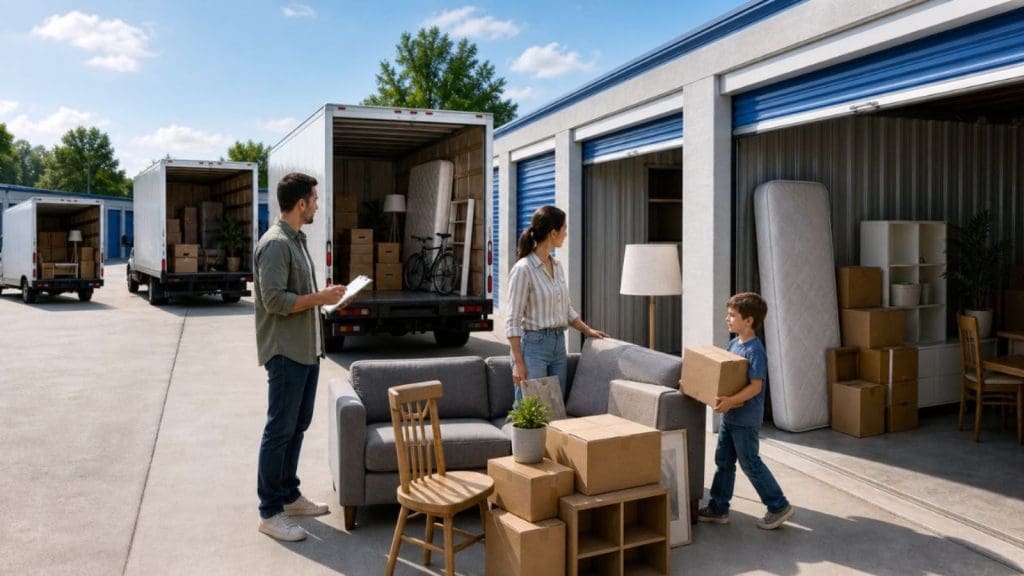
Renting a U-Haul truck is an important part of planning a move, but having somewhere to store your belongings can be just as important. Not every move involves going directly from one home into another, and temporary storage can help when moving schedules, available space, or other circumstances don’t line up.
There are several situations where renting a U-Haul and a storage unit can go hand in hand:
- Between homes: If you’ve moved out of your previous home but haven’t moved into your next one, a storage unit can provide a temporary place for your belongings.
- Downsizing: Moving into a smaller home may leave you with furniture and other items that won’t fit in the new space right away.
- Home renovations: Temporary storage can help keep furniture, appliances, and other belongings out of the way while work is being completed.
- Delayed move-in dates: If your new home isn’t ready as expected, a storage unit can help bridge the gap.
- Relocating for work: A job-related move may require temporary storage while you arrange housing or settle into a new area.
- Helping a family member move: Storage can provide additional flexibility when assisting a parent, relative, or other family member with a move.
- Temporary storage during a move: Even when move-in dates line up, you may prefer to move certain belongings into storage while getting organized.
Planning for storage ahead of time can make the moving process more manageable, especially when you aren’t ready to bring everything into your new home at once.
At Armor Storage, you can explore available storage unit options to find a solution that fits your belongings and moving timeline. Whether you need storage for a few weeks or longer, choosing the right amount of space can help keep your move organized.
Think About How You’ll Pack the Storage Unit
Choosing the right storage unit size is only part of the process. How you pack it can significantly affect how much usable space you have.
Place sturdy, heavier belongings where they can provide a stable base, and avoid putting heavy boxes on fragile items. Keep boxes containing belongings you may need closer to the front of the unit.
If furniture can be safely disassembled, removing table legs, shelves, or other components can make larger pieces easier to arrange. Keep hardware and small parts labeled and stored with the corresponding furniture so they’re easy to find later.
It’s also a good idea to use consistent, durable boxes or storage totes when possible. Armor Storage offers moving and packing supplies, making it easier to pick up materials you may need while preparing your belongings for storage.
Recheck Your Estimate Before Moving Day
Packing can reveal that your original estimate was off.
Books, kitchenware, clothing, seasonal decorations, and other smaller belongings can produce substantially more boxes than expected. You may also decide to keep furniture originally planned for sale or discover additional items in garages, closets, attics, or other storage areas.
Before finalizing your move, ask:
- Has the amount of furniture changed?
- Has the number of boxes increased substantially?
- Are there additional bulky or unusually shaped items?
- Will you need to access belongings while they’re in storage?
- Does your current unit provide enough room to organize everything safely?
If the inventory has changed significantly, reassess the space requirement before moving day. Adjusting the plan beforehand is much easier than discovering after the truck is loaded that the available storage space is inadequate.
Base the Size on Your Actual Inventory
Bedroom count can provide a rough starting point, but it doesn’t show how much furniture, equipment, or boxed belongings actually need to be moved.
The better approach is to start with your largest belongings, estimate your packed boxes, and consider how everything will need to be arranged during both transportation and storage.
For the storage unit specifically, think beyond whether everything will technically fit. Consider whether you’ll need a walkway, how often you’ll access your belongings, which items need to remain near the front, and how effectively you can use vertical space.
Taking a little extra time to assess your actual inventory can help you choose a moving truck and storage unit that better fit the way you plan to move and store your belongings.
Frequently Asked Questions
Should I estimate storage space before packing?
Yes. You can make a preliminary estimate before packing, but it becomes more reliable once you’ve measured large furniture and have a better idea of how many boxes and other belongings you’ll be storing.
Do disassembled furniture pieces take less storage space?
Often, yes. Removing legs, shelves, or other removable components can make certain furniture easier to arrange. Keep the parts and hardware protected, labeled, and stored together so they aren’t misplaced.
Does stacking boxes always save storage space?
Stacking can make better use of vertical space, but boxes should be stacked according to their weight and durability. Heavy boxes placed on fragile or lightweight items can cause damage and make the unit harder to access.
Should I consider furniture weight when choosing a moving truck?
Yes. A truck needs to accommodate both the physical volume and weight of the load. Heavy appliances, solid-wood furniture, and other dense items can affect truck selection even when there appears to be unused cargo space.
What if I am between two storage unit sizes?
Consider how tightly your belongings can be arranged and how often you will need to access them. If the smaller option would require difficult stacking or make important belongings hard to reach, additional space may provide a more practical arrangement.
Armor Storage | Find a Self-Storage Facility Near You
Armor Storage offers clean, secure, and conveniently located self-storage units across Kansas, Iowa, and Nebraska. Whether you’re moving, decluttering, or need extra space for your business, our facilities provide a variety of unit options and sizes, parking for RV, boats, and vehicles, flexible month-to-month rentals, and modern amenities like 24/7 security cameras and computerized gate access. With friendly on-site managers and customer-focused service, we make storage simple and stress-free.
We proudly serve multiple communities with locations in Omaha, Gretna, Bellevue, Ralston, Blair, Council Bluffs, Topeka, and beyond. Visit our Locations Page to find your nearest Armor Storage facility.
Contact your local Armor Storage today for current availability, rates, and promotions.